

The Sui team recently spent a week in Bhutan, one of the most remote places in the world, to test a big question: Can blockchain still work when the internet disappears?
This may sound unusual, but it matters. Many blockchains assume you always have strong internet, fast connections, and stable power. In the real world, this is often not true.
Bhutan, with its steep Himalayan mountains and patchy signal, was the perfect place to see what happens when technology meets real-world limits. Let’s discuss the result
What Sui Wanted To Learn

The main goal was very simple: Can a device still send safe, trusted data to a blockchain even when it cannot get online?
In many rural areas; farms, forests, and villages have little or no internet. But these places still need tools that help them measure crops, check water levels, track land, and prove that resources exist.
For example:
- A soil sensor may sit deep in a valley with no network
- A water meter may be far from any tower
- A forest monitor may be blocked by a mountain ridge
If these devices cannot connect, how do you trust their data?
Sui wanted to see if a sensor could sign a message offline, have it carried through the physical world, and still land safely on the blockchain.
Bhutan gave the perfect environment to test this. The region is working on new digital projects for agriculture, natural resources, and rural development. This strong interest in innovation, along with its difficult terrain, made it a useful location for real-world testing.
What The Team Discovered In Bhutan
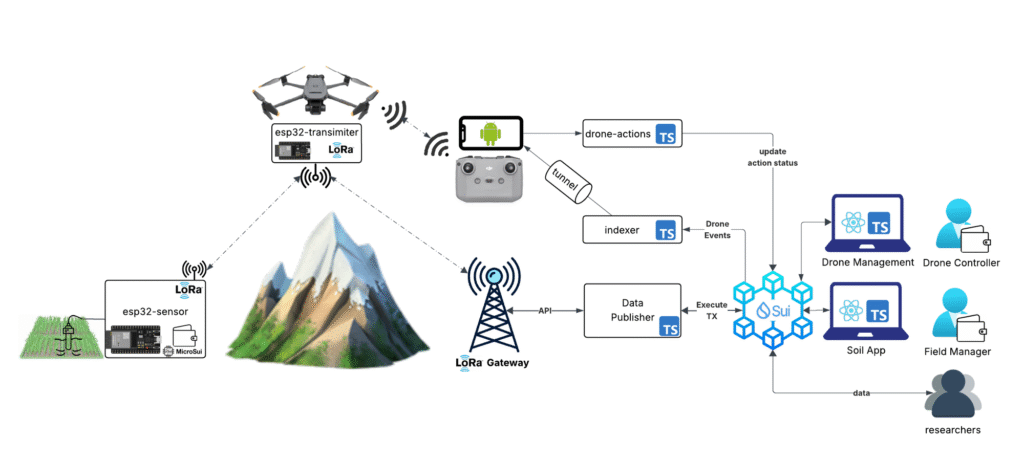
The trip showed quickly that theory and reality are very different. Internet signals broke often. Radio messages died behind mountains. Even simple tools behaved differently in the field.
To solve this, the team tried a mix of creative ideas:
1. Long-range radio messages
These radios can send data far, but the mountains often blocked them. Still, they worked in many open areas and helped move data from one point to another.
2. Drones carrying messages
When the radio failed, drones acted like “flying messengers.”
A drone picked up the signed message from one side of the ridge, flew it across, and sent it to the next relay. After a few hops, the message finally reached a place with internet.
3. Very tiny Sui messages
Because the signal was weak, the Sui team made the transaction size extremely small. Devices only had to send a tiny signed “intent,” which validators could rebuild later.
4. Sensors that sign directly
The sensors carried small cryptographic wallets. This let each device sign its own message, proving it was real and unchanged, even if it passed through many hands.
In simple terms: Sign offline → carry physically → upload when possible.
And it worked.
Why This Matters for Bhutan and Sui

Bhutan wants to modernize its economy, but many faraway regions have no stable connection. With this new method, a sensor deep in a valley can still create a trusted digital record.
This helps the country:
- Prove crops or resources exist
- Track environmental data
- Build fair markets based on real numbers
- Use modern tools without needing 24/7 internet
For Bhutan, this is not theory; it is a practical solution to a real problem.
And for Sui, the Bhutan trip was not a commercial launch. It was an engineering challenge, one that showed the power of designing blockchain systems that solve real problems.